Tuesday, August 25, 2009

100 Species Challenge #64

Specimen #64 Great Blue Lobelia
 Lobelia siphilitica

Photo by me. On a bank of the Raccoon River.

Native to Iowa according to Iowa Living Roadway (hat tip to Maria). I found only one of this forb, several of the monkey flower. The stripes caught my eye. I got pretty frustrated that I was too short to reach the "best" place to get a photograph.

I was surprised to find no active geocaches at Walnut Woods State Park, where this was photographed. The flowers can come in white. As with the monkeyflower, I find a very underwhelming supply of online information.

This plant has been found at Camp Dodge, Polk County, Iowa, as noted at this site.

Monday, August 24, 2009

100 Species Challenge #63 Monkey Flower

Specimen #63 Allegheny Monkey Flower

Mimulus ringens ringens

Photo by me. On a bank of the Raccoon River.

I'm fairly sure of this ID. Leaves come in pairs, lance-shaped. Flowers come in pairs. Yellow patches and squarish stems. All descriptions seem to match.

I am having a heck of a time finding information online on this plant. It seems to be endangered and threatened in some states. In fact, when I go to the Iowa County Level Distribution Map, our county has no report for monkeyflower. Or monkey-flower. Or is that monkey_flower? The name is possible part of the problem to it's being reported. I'm in the process of reporting the plants you see here to the USDA (Natural Resources Conservation Service).

My field guide says, "Children delight in squeezing the monkey-faced flowers to make them 'laugh.' Those who are curious enough may discover a more subtle trait: the stigma at the end of the pistil has two spreading lobes that fold together when touched with a needle or sharp twig. If the touch leaves behind pollen from a different plant, as a bee's tongue is likely to do, the lobes remain closed and the pistil sets seed. But if there is no pollen, or if the pollen is from the same flower, the lobes soon reopen."

The USDA submission form asks for gps coordinates, so I will need to revisit and take waypoints. I attempted to enter without coordinates, and was completely lost about township (no names, only combinations of letters and numbers were offered), section, etc. I've had this issue before when entering data for our beehive. I'll also investigate the 'folding lobes.' Sounds interesting.

Here are my kiddos. We went in mid-afternoon, but no signs of sunburn.

Thursday, August 20, 2009

It's a GIRL!


Our chrysalis grew darker after hanging more than seven days. The gold and black dots were like embellishments on a polished piece of green chrysoprase. Very beautiful. We all loved to wonder at it. But it changed. Daily. The wings of the adult grew more visible each day, as if someone was embossing the chrysalis deeper and deeper around the veins.

On the ninth day, we were like expectant parents. The chrysalis kept getting darker and darker. Not wanting to miss anything, someone would sit near the chrysalis at all times. Once nighttime fell, I knew it wouldn't come until morning. The butterfly would need warmth from the sun. "N" of GAIN and I took many pictures.

After pupating for ten days, we found we had a GIRL! She has thicker veins and no male scent spots on the lower wings to release pheromones (butterfly aftershave).

From egg to adulthood, keeping a monarch is very easy, as long as you have an easy way to feed the larva. I love that you can have a pet without needing a lot of maintenance and time -- you can't really pet it or keep it for very long, only about a month.

Tuesday, August 11, 2009

Chrysalis


Here's what we saw when we returned from our outing on Friday night. If all goes well, Muncher should emerge in 9 to 14 days, according Maria, who recently had a successful monarch hatching a couple days ago.

Sunday, August 9, 2009

Almost here!

Muncher grew at a rapid pace last week. Here he is with the remains of a leaf -- about one and half days' work for him. Or her. With all the guessing we've done about its adulthood, "A" of GAIN and I keep calling Muncher "him."


The climax was finding him on the lid I had constructed out of cardboard. I dumped all the leaves out of the jar and didn't even know he was up there until I went to replace the lid. No wonder I didn't find him on leaf! You can see the stick I placed in the jar for Muncher to climb when he was ready. (Or she.)

I removed the cardboard after getting a scolding from "I" and "N," (I could have killed Muncher on accident) then hung it from the light fixture over our seldom-used dining room table. (Why don't we use it? The reasons are too numerous to list here.)

After crawling around all morning, the neighbor kids and "I" of GAIN came to watch him for quite a bit in the late afternoon. He crawled all over the cardboard, under and on top of, a little on the light fixture, too. They disappointedly left without seeing any J formation. Sorry kids, things don't happen on our time, but God's time.

Upon waking the next morning, Muncher had finally settled down in a spot and was hanging in J formation. We checked him -- all.day.long. No joke. We kept the camera on the dining room table so we could catch him in the act of shedding his stripes for a chrysalis. But our schedule couldn't wait any longer. We were going to have to head to Sec Taylor/Principal Park. I predicted that he would change while we were away, and everyone agreed, we'd probably miss it. We did.

["N" of GAIN is using Muncher as his Photography Merit badge project, so witnessing as much as possible is key to his success. Luckily, we have a second caterpillar as a back up. Since it's smaller, -ette was added to make Munchette.]

Wednesday, August 5, 2009

100 Species # 62 -- Evening Primrose

Common Evening Primrose

Oenothera biennis

Photo by me, Pleasant Hill, near GC1FWQJ Groovin' with (dd) (archived) and GC1FWQ1 Hickory Plaza (active).

I see this plant frequently in "waste" areas. It's native, and very upright. Height varies greatly. The flowers are located at the top of the stalk in a cluster, and remind me of balloons. They are wide and open with a pinched neck, like a balloon.

I photographed this on a windy day, so I refer you to Illinois or Wisconsin's wildflower websites for a photo of the entire plant. I had to hold the stalk just to get this photo.

Evening primrose is currently used to aid various health problems as noted all over the internet, including here and here.

Monday, August 3, 2009

Growing


Muncher has been eating a lot today. Good thing A of GAIN grabbed some milkweed yesterday, because today is much hotter. We can safely say that he is now longer than one inch. I can't copy and paste his growth chart here in its current format, but I'll see what I can do.

Sunday, August 2, 2009

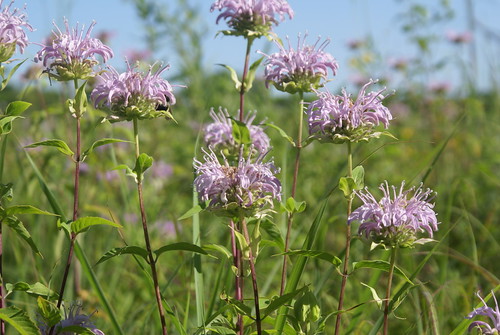
100 Species # 61 -- Wild Bergamot

Specimen #61

Wild Bergamot

Monarda fistulosa

Mint family (Lamiaceae)

Top photo by grandpaspix near Elkhart

Bottom photo by me near Boone

This flower may look familiar -- Bee Balm is a frequent garden variety of Monarda.

The Missouri Plants website has great informationfor this species if you would like to learn about its physical characteristics. The structure is very distinctive to me, making it easy to recognize.

I found this patch of bergamot north of Boone in a fence row. I have not seen wild bergamot very often. It is a field flower, and blooms from June through September.

If you visit the Illinois Museum website, you can read about some interesting uses this plant has had.